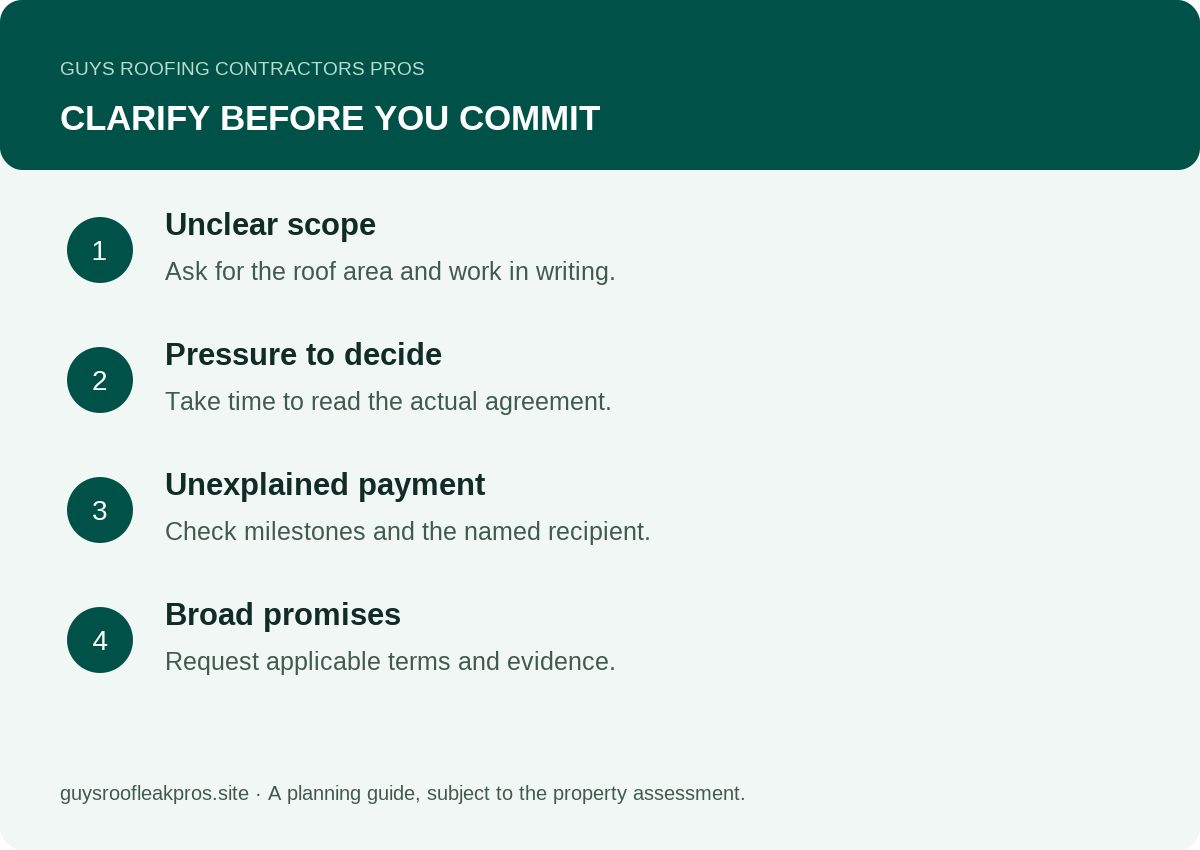
Roofing red flags include an unverifiable business identity, pressure to sign before reviewing the terms, an unclear work scope and requests for payment that do not match a documented agreement. Treat an unanswered question as something to resolve. Pause when the contractor refuses the information you need to understand or verify the job.
Is the problem simply missing information, or is someone trying to prevent you from checking it? That distinction matters. A proposal can need a correction without proving dishonesty. Refusing to identify the business or let you read the agreement is a different concern.
Use observable facts when reviewing an offer. Keep the document, the unanswered question and the response together. That is a stronger basis for a decision than a feeling about a sales pitch, and it helps you compare more than one provider fairly.
Can you verify which business is offering the work?
The business named on the estimate, payment request and project contact should be clear enough for you to check before you authorize work.
Look at the actual name on the proposal. If it differs from the name used in advertising or conversation, ask how the names relate. You should be able to identify the contracting business and the person handling your questions without guessing.
Ask for the relevant license and insurance information and verify it with the appropriate issuing source. A logo on a document is not the same thing as a checked record. If someone claims a certification or qualification that affects your decision, ask what it applies to and how it can be verified.
The federal consumer advice on contractor checks recommends verifying licensing and insurance, reviewing estimates and putting the agreement in writing. These checks apply to any provider, including one recommended by a friend. A recommendation helps you find a candidate; it does not replace checking the agreement for your project.
Does the estimate identify the roofing work?
An estimate that leaves the work area, materials or preparation undefined needs clarification before its total can be compared with another offer.
A line that says replace roof can hide several unanswered questions. Does the scope cover every roof section? What existing material will be removed? How will transitions and penetrations be treated? What remains outside the job?
A vague estimate is not automatically a scam. Ask for a revision that records the missing details. The warning becomes more serious if the contractor will not explain the scope or insists that specific terms are unnecessary. Clear work should be capable of being described.
Are you being pushed to decide before you can review the terms?
Urgency should be tied to an observed condition and a defined immediate step, rather than used to prevent you from reading or checking an agreement.
An active leak and a long-term replacement decision do not have to be bundled into one rushed choice. Ask what concern requires attention now, what action is proposed and what decisions can follow after assessment. Keep temporary measures and permanent work distinct in the paperwork.
Pressure can make a broad proposal feel like the only way to address an immediate concern. Ask whether the proposed urgent action has its own scope and limits. If someone will not give you time to understand what you are signing, pause.
After severe weather, use the same review process even when many properties need attention. The consumer guidance on weather-related repair scams warns about pressure, upfront cash demands and refusal to provide written documentation. A busy period does not explain away an unidentified business or an unread contract.
Leak or storm damage? Call now Tell us what you see on the roof or ceiling. We book an inspection and give you a written estimate.
Does the recommendation connect the findings to the solution?
A roofing recommendation should explain how the observed condition supports the proposed repair or replacement, including limits in the assessment.
Ask what evidence supports the conclusion. A photograph may show a damaged detail without establishing the extent of work needed elsewhere. A material's age can be relevant history without proving the condition of every roof section.
Be cautious about conclusions that skip those steps. You should not have to accept a large replacement scope merely because one problem was found, or accept a small patch without understanding what it is meant to address. Ask what the alternative would leave unchanged and why the proposed option fits the findings.
The same standard works in both directions. A cheaper repair is not useful if its scope does not address the identified problem. A larger replacement is not justified by price alone. Our repair information and replacement information describe different service conversations, rather than treating them as interchangeable answers.
Are payment and change requests traceable to the agreement?
Payment stages and additional work should refer to a documented scope, with a clear record of the amount, reason and approval involved.
Read the proposed payment arrangement before the work begins. Ask what each stage relates to and which documents accompany it. Keep receipts with the project records. An unexplained payment request should be resolved before money changes hands.
An example shows the distinction. A contractor discovers deteriorated decking after removal and sends photographs, a defined repair and a change price for approval. That is different from presenting an unexplained extra charge after the job. Review the process and evidence rather than assuming every change is either normal or dishonest.
Are warranty or insurance statements being used as substitutes for terms?
A broad warranty promise or an insurance prediction does not replace the actual coverage documents, written work scope or insurer's policy decision.
Ask who provides each warranty and which work or products it covers. Product and labor coverage can have different terms. If a proposal uses a broad label without identifying the applicable documents, request the documents before relying on the label.
Keep insurance questions separate from the roofing estimate. A roofer can document observed conditions and proposed work, but policy questions belong with the insurer. Do not treat a statement that insurance will pay as a confirmed decision on your claim. The manufacturer's storm recovery guidance directs homeowners to their agent or insurer for coverage questions.
Likewise, a promise of a long warranty does not make an unclear repair scope acceptable. You still need to understand what will be done now and who handles a concern later.
When should you clarify, compare or stop?
Clarify an isolated gap, compare proposals when their scopes differ, and stop when essential identity, documentation or review requests are refused.
This approach avoids two mistakes: dismissing every imperfect document as fraud, and accepting an important gap because the conversation feels reassuring. Focus on what is verifiable and on whether the contractor will resolve a reasonable question.